

Hanging Cabinet made by Wright & Mansfield of London
Hanging Cabinet made by Wright & Mansfield of London
English
circa 1860
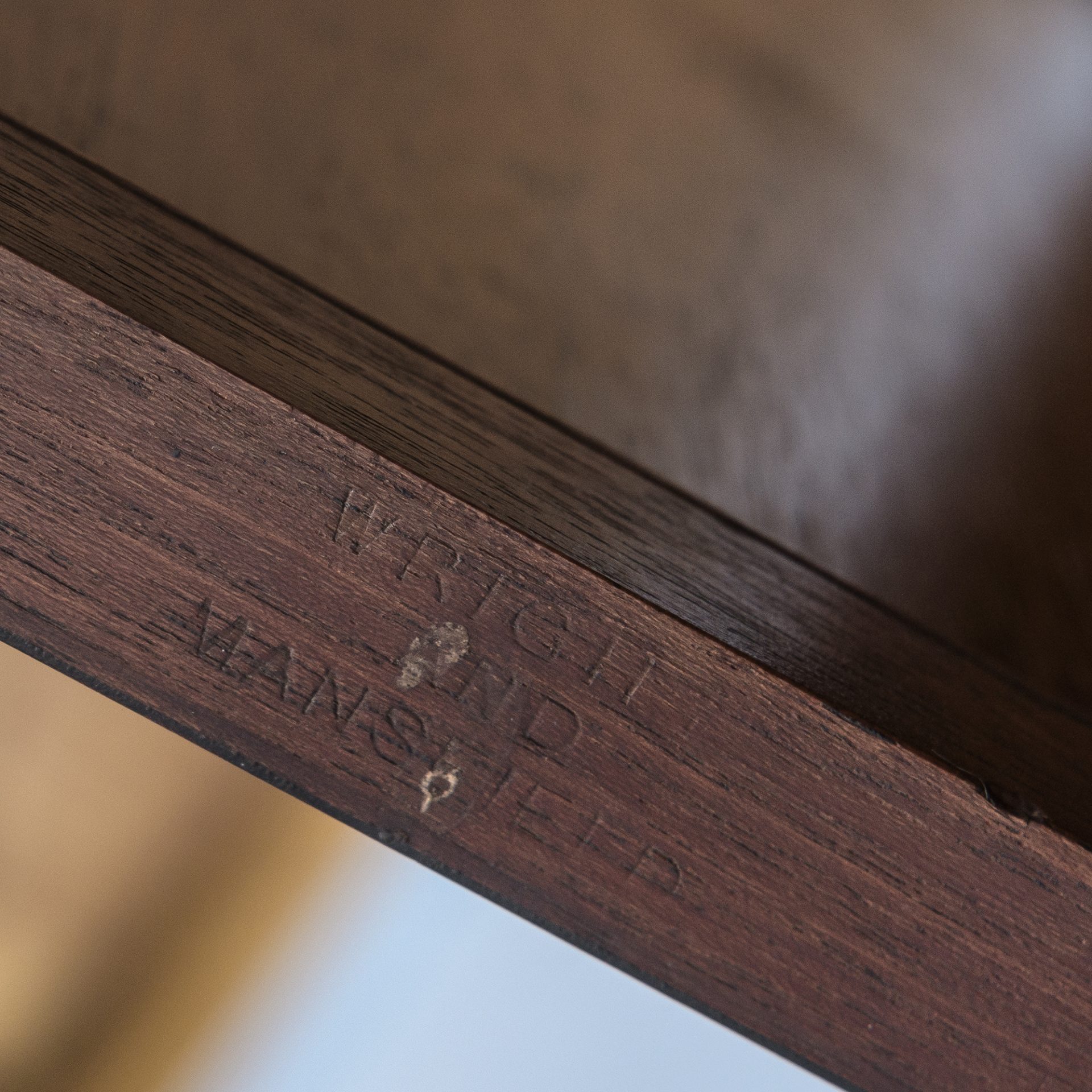
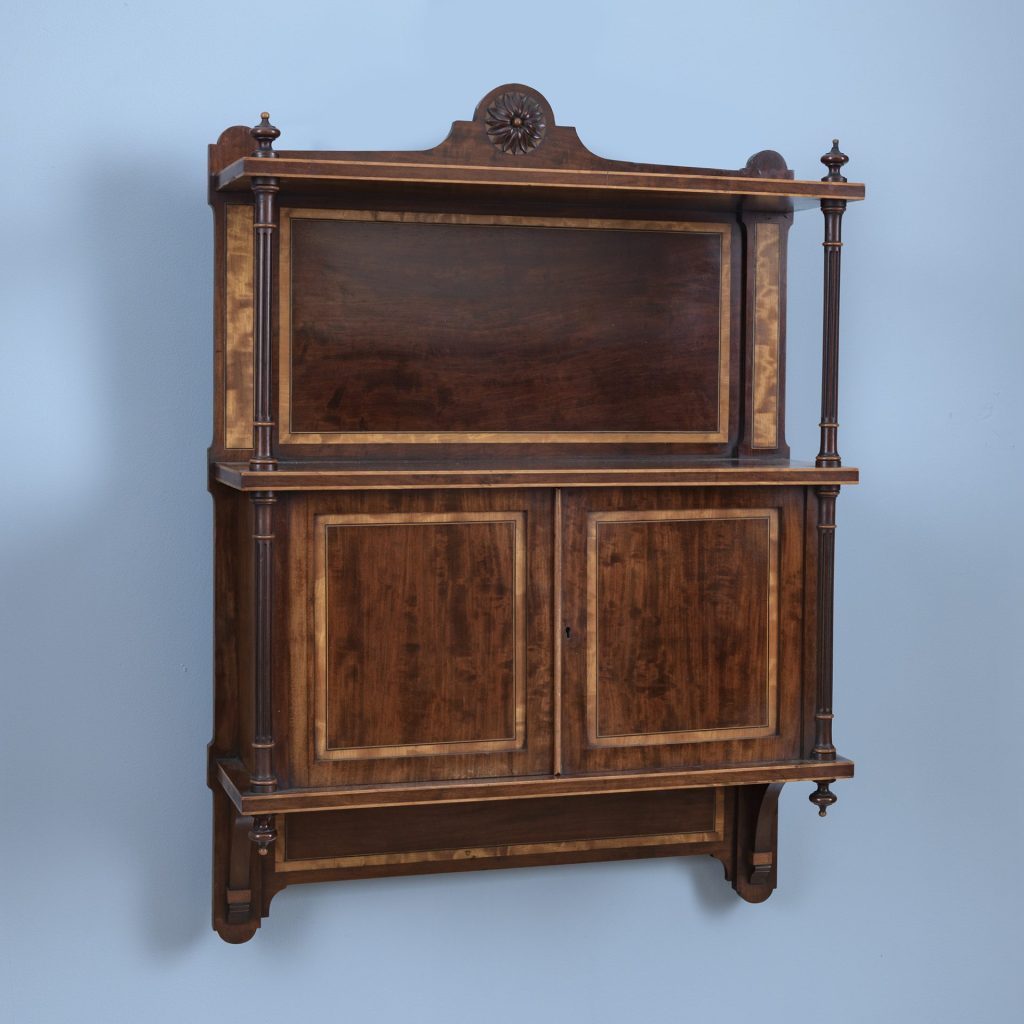
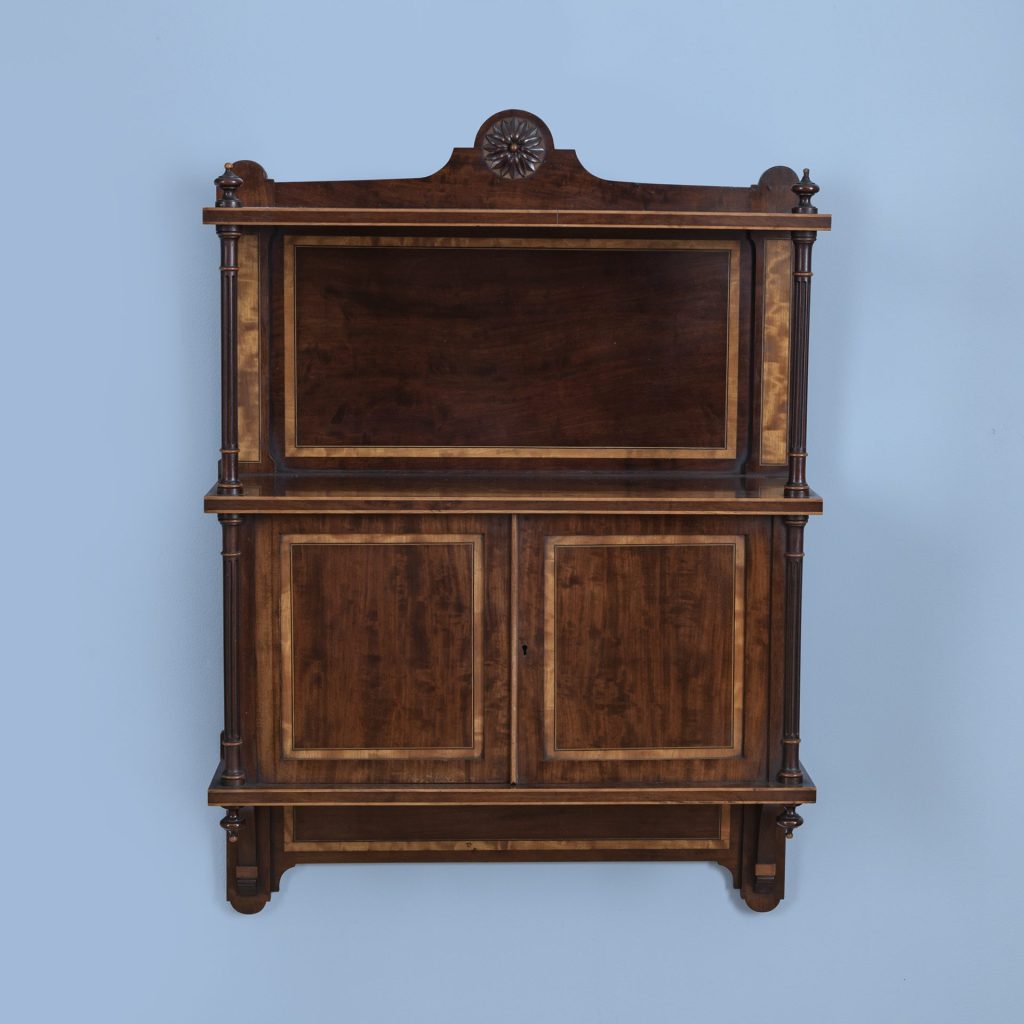
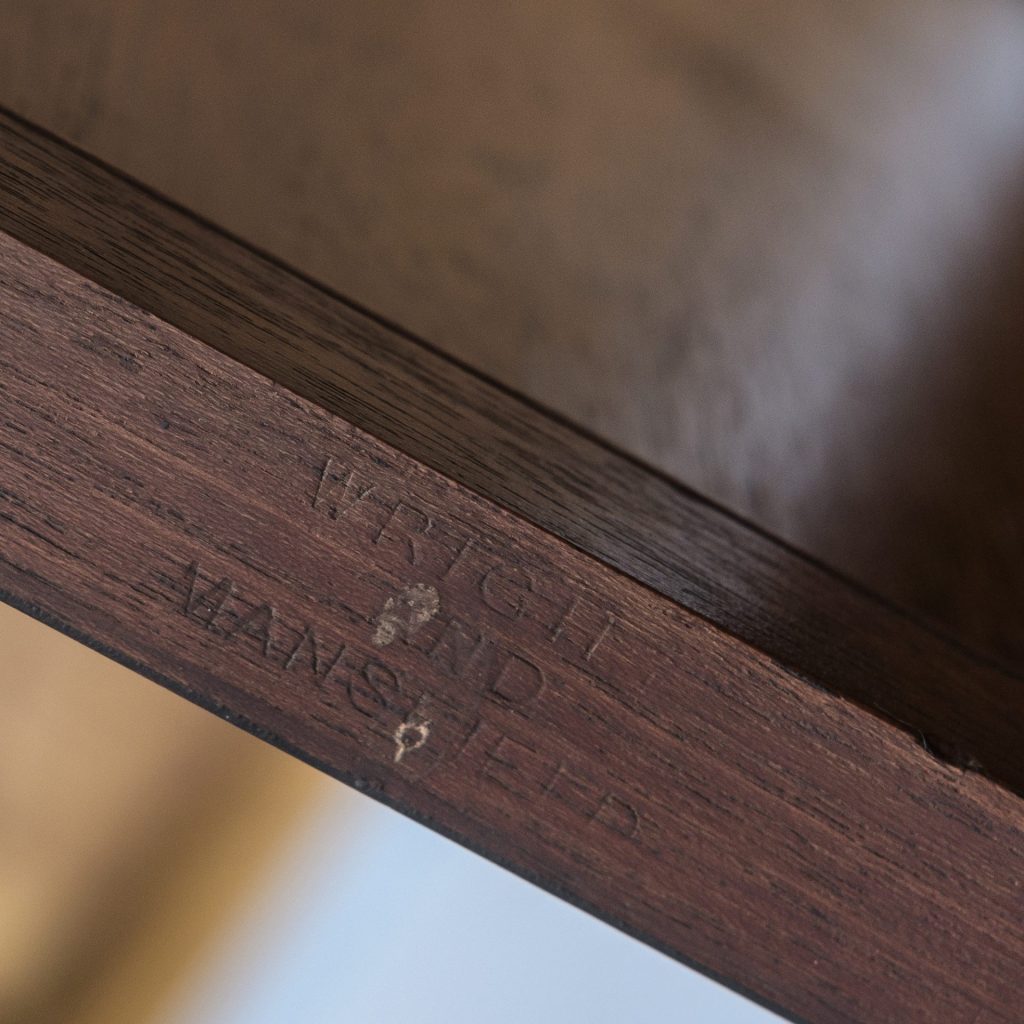
Mid 19th Century Wall Cabinet stamped with the makers impress twice
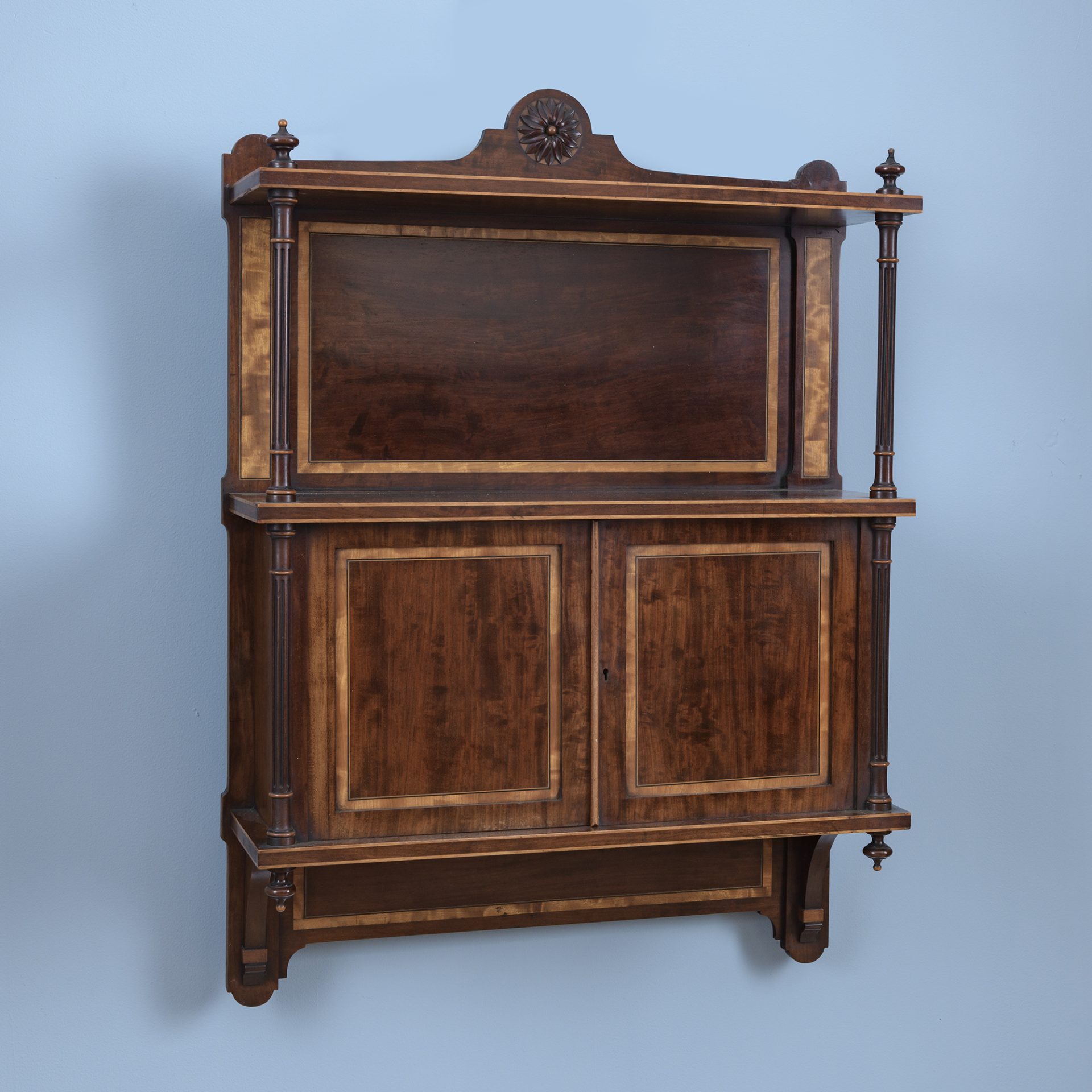
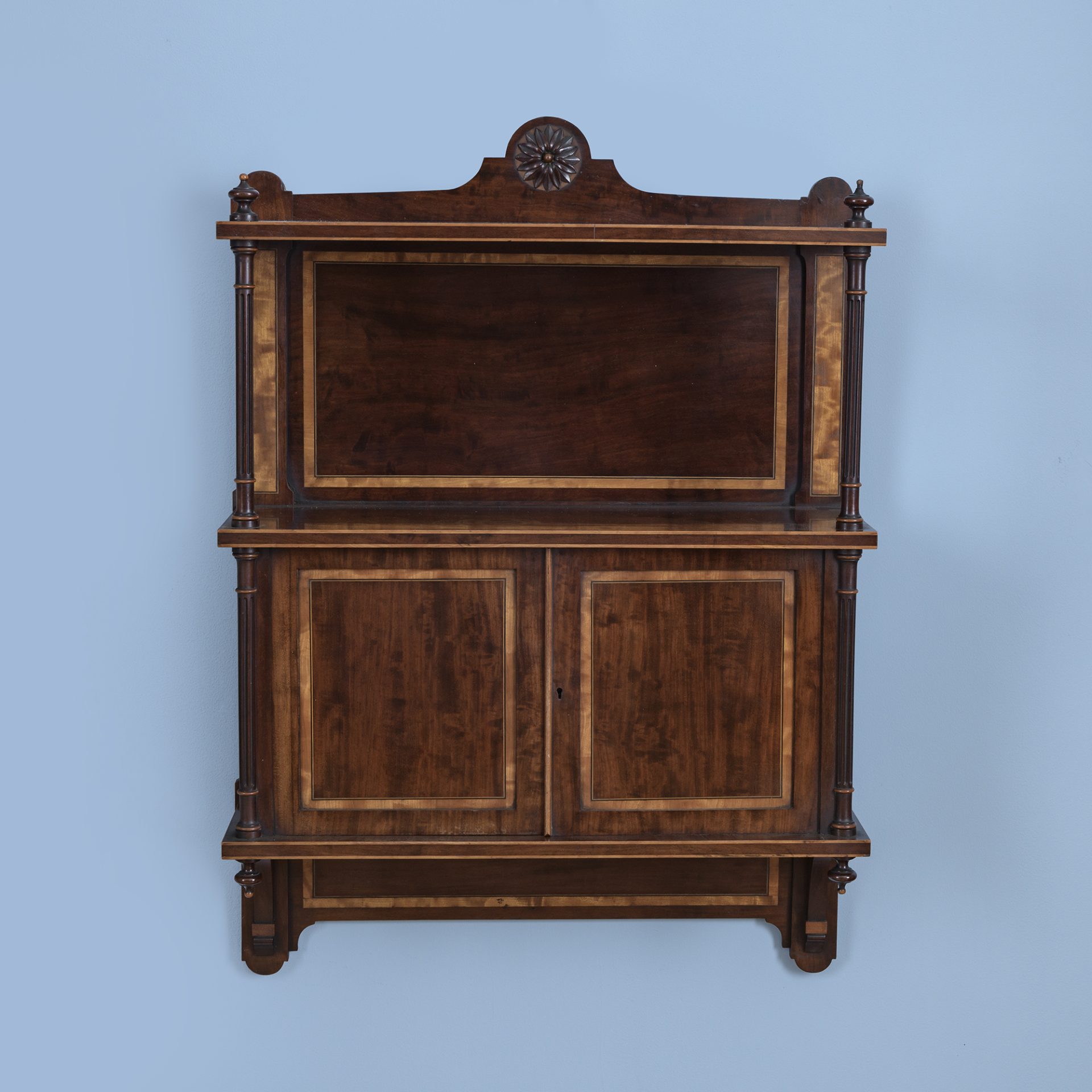
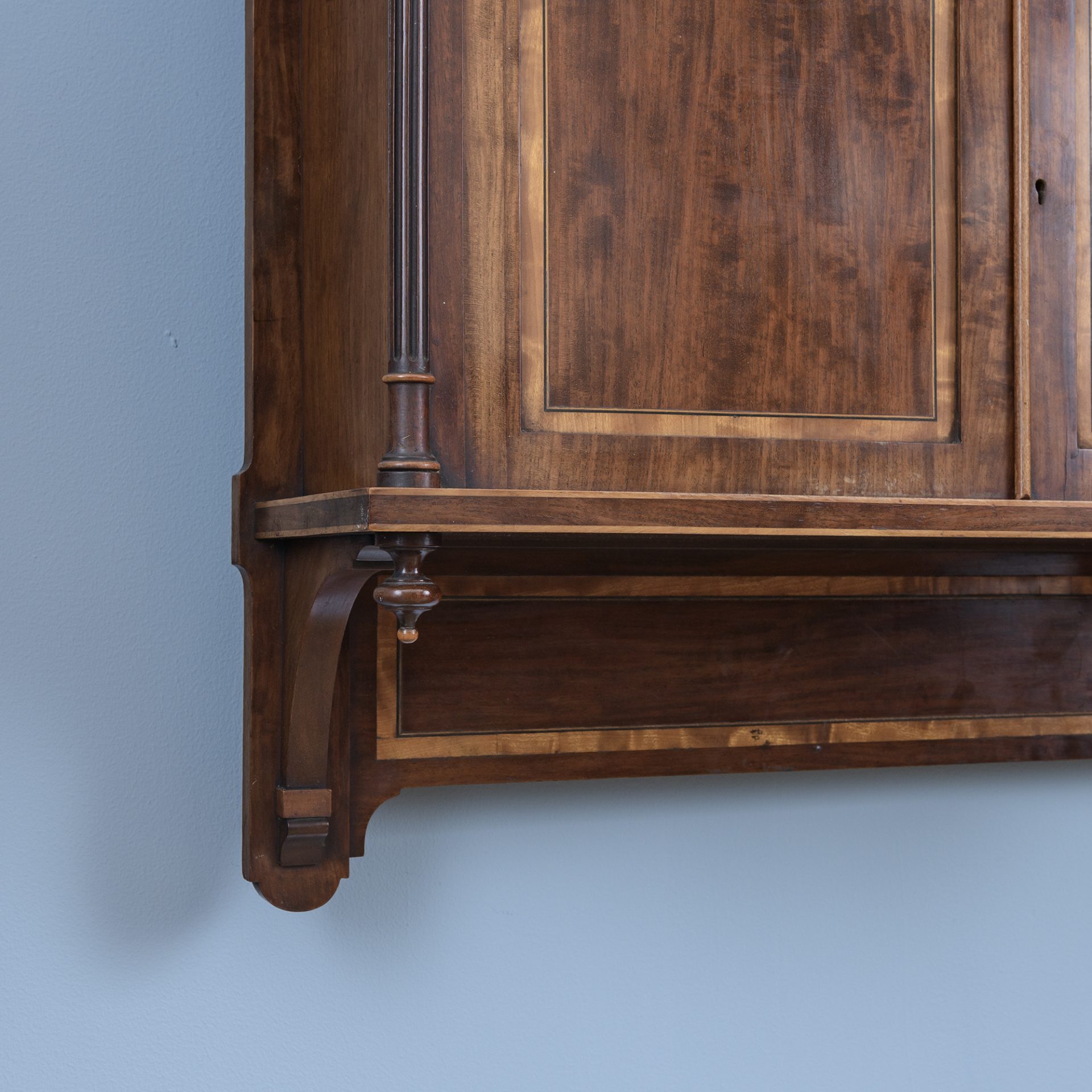
The shaped mahogany gallery surmounted to the top section is centralised with an applied crisply carved floral motif with solid carved finials to the flanks above ring turned and fluted mahogany columns with satinwood highlights.
The recessed backboard is veneered with a horizontal mahogany panel and cross banded with ebony & boxwood stringing and flanked with shaped inlaid capitals above a pair cupboard doors.
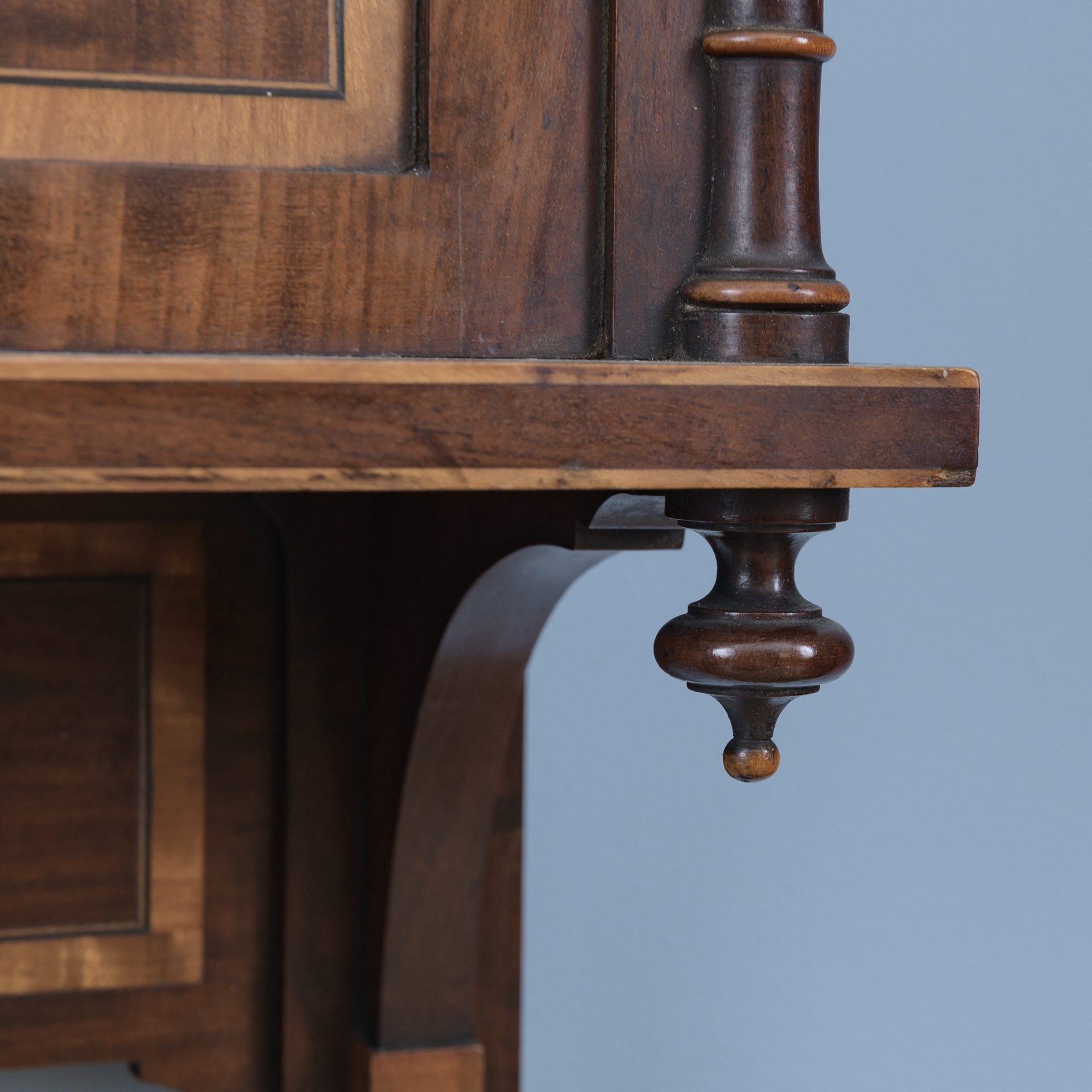
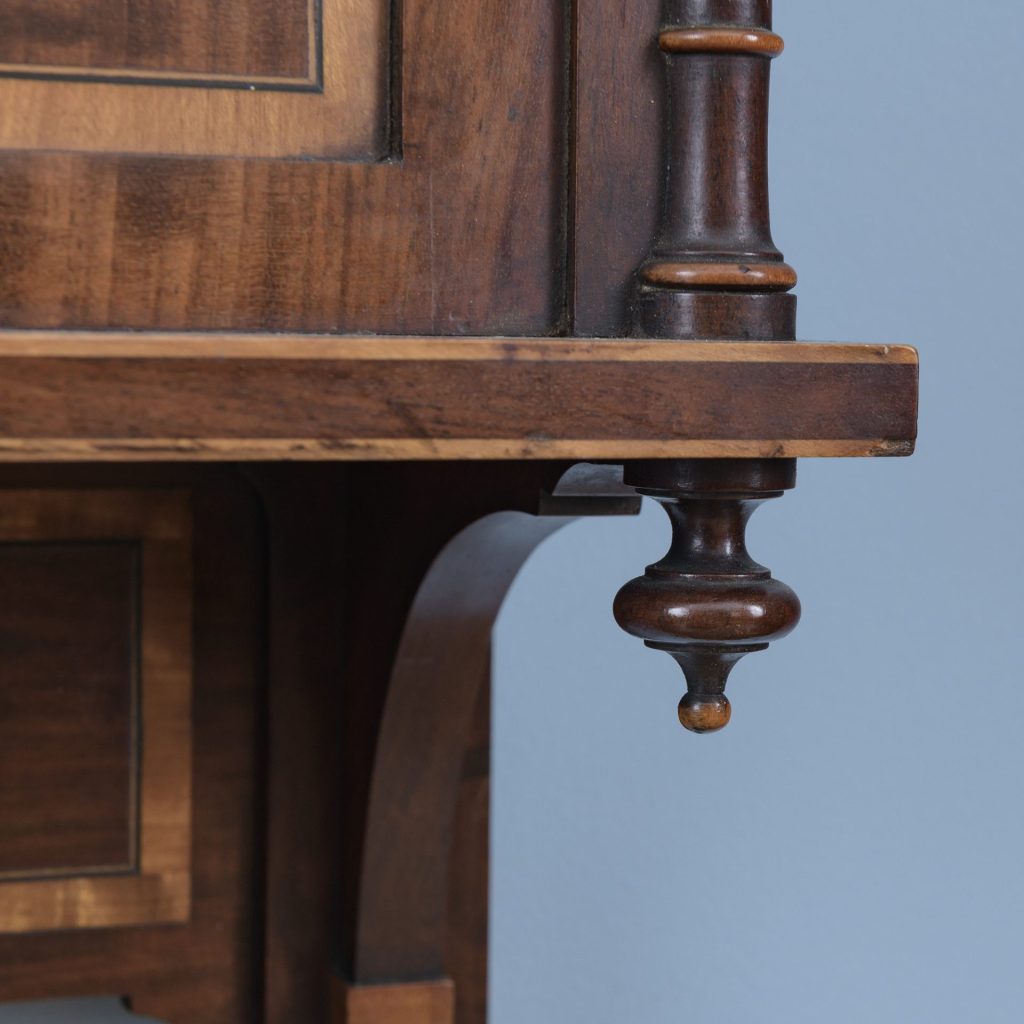
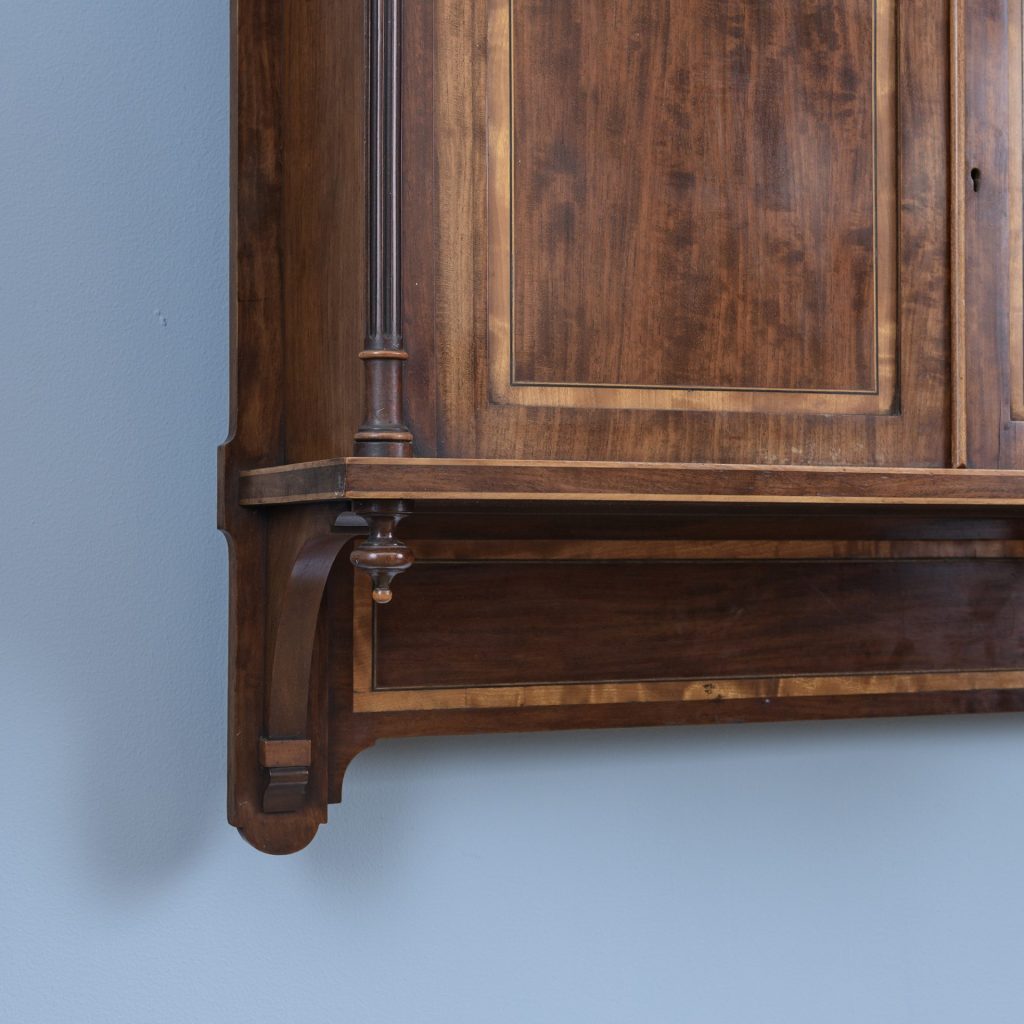
The figured cupboard doors are cross banded inlaid and adorned with fluted capitals above solid mahogany supports inverted satinwood tipped finials on a recessed shallow inlaid mahogany back panel.
One of the Victorian leading furniture makers who promoted interest in past revival pieces was the London firm of Wright and Mansfield, whose range of ‘Chippendale Furniture’, from chairs, library tables, sideboards and mirrors, was often advertised in their illustrated trade catalogues. Working as cabinet makers and upholsterers, the partnership between Alfred Thomas Wright (1840-90) and George Needham Mansfield (1828-95) was significant but only flourished for a relatively short period, roughly between 1861 and 1884. Alfred Thomas Wright, who was born in Bethnal Green, Middlesex was the son of a paper stainer, Joseph Richard Wright. From 1856 Alfred worked for and later became a junior partner to Samuel Hanson, a cabinet maker and ‘antiquarian upholsterer’ of 16 John Street (later Great Portland Street) and 106 Oxford Street. In 1858, George Needham Mansfield, the son of George Mansfield, a builder and decorator of Gray’s Inn Lane and Wigmore Street, joined the firm which then traded as Hanson, Wright and Mansfield until Hanson’s death in 1861. Thereafter the firm traded as Wright and Mansfield.
Wright and Mansfield exhibited at the London International Exhibition of 1862, where they won a first-class medal. Among many pieces, their stand included a piano made by Érard, which was painted by Pincon and Prolisch, featuring carvings by R. W. Godfrey. The piano was bought by D. C. Marjoribanks, M.P., of Guisachan House, Inverness and was part of a large commission of Adam-style furniture made by the firm, the earliest so far documented. A particular feature of this cabinet furniture was the incorporation of Wedgewood plaques, including black basalt ware and the use of Highland black cherry wood. The firm subsequently furnished the Marjoribanks family London residence Brook House (1867) and Haddo House, Aberdeenshire (during the 1880s), belonging to D. C. Majoribanks’ son in law and daughter, the 7th Earl and Countess of Aberdeen.
At the 1867 Paris Universelle Exposition, the firm showed a remarkable satinwood, marquetry, bronze and Wedgwood mounted cabinet. It was awarded a gold medal, the only time such an honour was bestowed upon an English cabinet maker, by the judges, presided over by M. du Sommerard director of the Cluny Museum, and M. Wilkinson, Administrator de Mobilier de la Courrone. The medal was presented personally to Wright & Mansfield by the Emperor Napoleon III. The cabinet was purchased by the South Kensington Museum (later the Victoria and Albert Museum) for the extraordinary sum, in those days, of £800. It remains in their possession today.
The firm’s listing in the 1871 Post Office Directory recorded addresses at 104 New Bond Street, 3 Great Portland Street & 6 Ridinghouse Street, London. A drawing room in the style of ‘the Adam brothers’ shown at the 1876 Philadelphia Centennial Exhibition was awarded a medal and was most favourably commented upon in the journals of the day. In addition to the above, other examples of the firm’s work include a satinwood display cabinet of about 1870, formerly in the Handley-Read collection, at the Cecil Higgins Arts Gallery and Museum, Bedford and a painted satinwood armchair with cane seat made in about 1880, now in the V&A, London.
Haddo House was probably Wright and Mansfield’s last major commission, and it is unlikely it was completely finished before the partnership was formally dissolved in December 1884. Nevertheless, the firm continued to advertise until 1885/6 and were recorded in the Furniture Gazette Classified List of the Furniture, Upholstery and Allied Trades, 1886, as ‘Art Furniture Manufacturers and Merchants’. The reasons for the firm’s dissolution are unclear, but Wright was probably unwell by this time and there may have been financial mismanagement because Wright only left £312 8s 3d at his death in 1890. Wright and Mansfield furniture was expensive and perhaps unaffordable to all but the very rich. Furthermore, the firm had invested considerable capital in a collection of important specimens used as models for their reproduction furniture which The Cabinet Maker & Art Furnisher(1st July 1887) described as ‘[equal to] the real work of the best makers, Chippendale, Sheraton, Hepplewhite, Adam and Richardson [which was] becoming scarcer in auction rooms, and fetch[ing] high prices’. Their stock was dispersed in two sales conducted by Phillips, Son and Neale in June 1886 and June 1887. At the latter auction, the South Kensington Museum, V&A, acquired a selection of marquetry panels, pilasters, a Pembroke table and pair of Sheraton style chairs.
George Mansfield, with his brother, attempted to carry on the business as before, buying stock from the 1886 sale, but was forced to close in 1887 and the premises was sold. George, of Myrtle Cottage, Littlewick Green, Berkshire, died in 1895 on the Isle of Wight, leaving effects to the value of £1,030 to his wife, Augusta Maria. Wright and Mansfield’s name obviously held weight even after it had closed its business since when George Frederick Dean of Davies Street, London, a designer and dealer in the fine and decorative arts, placed an advertisement in The Connoisseur, in 1902, he noted he had been the ‘designer and adviser to the late firms of Messrs. Wright & Mansfield and Messrs. Edwards & Roberts’.
Condition
The makers impress is found on the reverse and on the top of the right hand door.
Dimensions
Height 75.00cm (29.53 inches)
Width 57.00cm (22.44 inches)
Depth 18.50cm (7.28 inches)
Sold
© 2026 Freshfords Fine Antiques